How Does the Polishing Path Affect the Performance of a Stone Polishing Machine?
In the stone processing industry, achieving a smooth, high-gloss surface finish depends not only on the quality of abrasives and polishing tools but also on the design of the polishing path. The polishing path of a stone polishing machine directly affects surface uniformity, processing efficiency, and final product quality.
Whether processing granite slabs, marble tiles, engineered stone, or other natural stone materials, selecting the correct polishing path helps reduce surface defects, improve polishing consistency, and increase production efficiency. Modern automatic and CNC stone polishing machines use advanced control systems to optimize polishing movements and achieve precise finishing results.
What Is the Polishing Path of a Stone Polishing Machine?
The polishing path refers to the programmed movement trajectory of the polishing head during the polishing process. It determines how the abrasive tool moves across the stone surface and ensures that every area receives sufficient and uniform polishing pressure.
A properly designed polishing path should achieve:
- Uniform contact between the polishing head and stone surface
- Consistent gloss and surface smoothness
- Reduced polishing marks and uneven areas
- Higher processing efficiency
- Longer abrasive tool lifespan
The design of the polishing path depends on several factors, including stone hardness, slab size, surface shape, required gloss level, and machine structure.
Common Types of Polishing Paths
Linear Polishing Path
The linear polishing path is one of the most common methods used in automatic stone polishing machines. The polishing head moves back and forth in straight lines across the stone surface.
This method is suitable for large flat stone slabs because it provides:
- High processing efficiency
- Stable polishing pressure
- Simple programming and operation
- Consistent surface finishing
It is widely used in granite slab polishing and marble slab production lines.
Cross or Grid Polishing Path
The grid polishing path combines horizontal and vertical movements to increase surface coverage. Compared with a single-direction polishing method, the cross movement can improve polishing uniformity and reduce directional polishing marks.
This polishing method is especially useful when higher surface quality and better gloss consistency are required.
Circular Polishing Path
Circular polishing movements are commonly used in manual polishing machines and small-area repair applications. The operator moves the polishing tool in a controlled circular motion to evenly distribute polishing compounds and abrasives.
This method is suitable for:
- Stone countertop repair
- Edge finishing
- Local surface restoration
- Special-shaped stone products
Polishing Paths for Different Types of Stone Polishing Machines
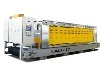
Automatic Stone Slab Polishing Machine
The Automatic Stone Slab Polishing Machine is designed for continuous large-scale stone production. Its polishing path is controlled by an automatic system to ensure stable movement across the entire slab surface.
During the polishing process, the machine usually follows multiple stages:
- Rough grinding: Removes surface unevenness and machining marks.
- Fine grinding: Improves surface smoothness.
- Polishing: Creates the required gloss level.
The automatic control system ensures that each polishing head follows the programmed path accurately, reducing manual adjustment and improving production efficiency.
Granite Chamfering Edge Slab Polishing Machine
The Granite Chamfering Edge Slab Polishing Machine focuses on polishing granite slab edges and chamfered surfaces.
Unlike flat slab polishing, the polishing path must follow the specific edge angle and shape. The machine adjusts the polishing head movement according to:
- Chamfer angle
- Edge width
- Stone thickness
- Required finishing quality
A precise polishing path ensures smooth edges, uniform gloss, and better visual appearance.
Edge Polishing Machine
The Edge Polishing Machine is specially designed for processing stone edges, including straight edges, curved edges, and special profiles.
The polishing path follows the edge contour to maintain constant contact between the polishing tool and the stone surface. This prevents uneven polishing and improves edge quality.
Manual Nature Stone Polishing Machine
The Manual Nature Stone Polishing Machine provides greater flexibility because operators can manually control the polishing direction and pressure.
Experienced operators can adjust the polishing path according to natural stone characteristics, such as:
- Stone texture
- Surface defects
- Uneven areas
- Special decorative requirements
Hand Polishing Machine for Granite and Marble
The Hand Polishing Machine For Granite Marble is commonly used for repair work, edge polishing, and areas that cannot be processed by automatic machines.
The operator usually applies circular or linear polishing movements depending on the surface condition. This allows precise finishing for complex stone applications.
Factors Affecting the Design of a Polishing Path
Stone Material Characteristics
Different stones require different polishing strategies. Granite has higher hardness and usually requires stronger grinding pressure, while marble requires more delicate polishing to avoid surface damage.
Surface Shape and Size
Large flat slabs can use simple linear paths, while curved or irregular stone products require more complex movement patterns.
Required Surface Finish
The required gloss level also affects polishing path design. High-gloss surfaces usually require multiple polishing stages with precise movement control.
How CNC Technology Improves Polishing Path Control
Modern CNC stone polishing machines have greatly improved polishing accuracy and automation levels. Through computer-controlled programming, CNC systems can create complex polishing paths with high repeatability.
Main advantages include:
- Higher polishing precision
- Stable product quality
- Reduced operator dependence
- Improved production efficiency
- Ability to process complex shapes
Advanced sensors and automatic adjustment systems can also monitor surface conditions and optimize polishing parameters during operation.
How to Choose the Right Polishing Machine for Your Application
When selecting a stone polishing machine, manufacturers should consider:
- Stone type: Granite, marble, quartz, or other materials.
- Production capacity: Small workshop or large-scale factory production.
- Product shape: Slabs, edges, countertops, or special profiles.
- Required finish: Matte, satin, or high-gloss polishing.
Choosing a machine with a suitable polishing path control system can significantly improve processing efficiency and product quality.
Conclusion
The polishing path is a key factor that determines the performance of a stone polishing machine. A well-designed polishing path ensures uniform abrasive contact, stable processing quality, and improved production efficiency.
From automatic slab polishing machines to edge polishing equipment and CNC polishing systems, modern stone processing technology provides flexible solutions for different applications.
If you are looking for a reliable stone polishing machine for granite, marble, or other stone materials, our professional team can provide customized solutions according to your production requirements. Contact us today to learn more about advanced polishing technology and equipment.