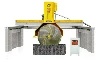
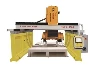
Stone Slab Cutting Equipment:
The process of stone fabrication begins with cutting raw materials into slabs. Various cutting machines are employed for this purpose, each with distinct features and applications.
- Wire Saws (Pull Saws): Ideal for large-scale production of marble slabs, wire saws offer high efficiency and produce slabs with minimal thickness variation. They are categorized based on manufacturing principles, the number of installed wire ropes, and the running mode of the saw frame and raw material carriage.
- Blade Saws: These are primarily used for cutting granite blocks and require the addition of steel grit, lime, and appropriate mud to facilitate cutting. Unlike wire saws, blade saws rely on a slurry mixture to enhance cutting efficiency.
- Single-Disk Saws: Equipped with a single cutting disc, these saws are versatile and cost-effective, suitable for cutting slabs of various thicknesses. They are particularly popular for small batch production with multiple thickness and variety requirements.
- Combination Saws (Set Saws): These saws can accommodate multiple cutting discs, offering flexibility in processing different types of stone materials.
- Bi-directional Cutting Machines: Featuring cutting discs in both vertical and horizontal directions, these machines provide efficient and precise cutting capabilities.
- Diamond Bead Rope Saws: Utilizing diamond beads on a rope, these saws are designed for cutting large stone blocks and offer high cutting precision and efficiency.
Stone Processing Techniques: The process of stone slab cutting involves several steps, from material selection to final cleaning and sorting. The workflow typically includes:
- Material Selection: Carefully selecting raw materials based on specifications such as name, color, pattern, quantity, thickness, and size requirements.
- Material Reinforcement: Strengthening raw materials with cracks or defects using methods such as fiber mesh and adhesive, stone plate reinforcement, or injection of resin.
- Sawing Process: The actual cutting of the stone slabs, which includes preparing the machine, trial cuts, and the main cutting process.
- Post-Cutting Operations: After the slabs are cut, they are cleaned, sorted, numbered, and removed from the machine for further processing.
Conclusion:
Stone processing machinery plays a pivotal role in the stone industry, ensuring high-quality and efficient production. As technology continues to evolve, we can expect further innovations that will streamline the stone fabrication process and improve the quality of finished products.